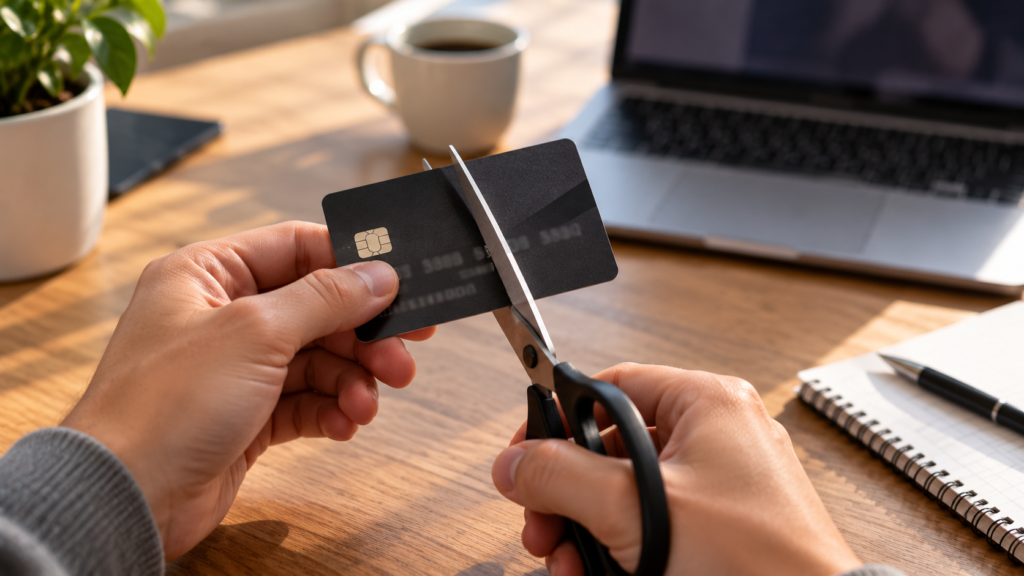
It can. Closing a card removes its credit limit, so if you carry balances on other cards, your credit utilization goes up. With $3,000 of balances, closing a $10,000-limit card out of $20,000 in total limits takes your utilization from 15% to 30%. If you have no balances, the effect is usually small.
Why closing a card can lower your score
Two parts of your credit can change:
- Credit utilization: the share of your available credit you’re using. Fewer limits means a higher ratio for the same balances. It can change your score as soon as the new numbers are reported.
- Length of credit history: a closed account in good standing can stay on your credit report for years, so this effect usually appears slowly, if at all.
The utilization math
Say you have three cards and owe $3,000 in total:
| Scenario | Total limits | Balances | Utilization |
|---|---|---|---|
| Keep all three cards | $20,000 | $3,000 | 15% |
| Close the $10,000 card | $10,000 | $3,000 | 30% |
| Keep all and get a $3,000 limit increase | $23,000 | $3,000 | 13% |
Lower utilization generally helps your score; under 30% is a common guideline. Our credit utilization guide explains how it’s calculated per card and overall.
When closing a card makes sense
- It has an annual fee you can’t justify and the issuer won’t waive it or switch you to a no-fee card. See is an annual fee worth it.
- It tempts you to overspend, and having it open is hurting your budget.
- You’re not planning a big loan soon, such as a car loan, so a small, temporary score change matters less.
How to close a card the right way
- Pay the balance to $0 and wait for any pending charges to post.
- Use or transfer your rewards; they’re often lost when the account closes.
- Move automatic payments, like streaming or phone bills, to another card.
- Ask about a product change to a no-fee card from the same issuer. It keeps the account and its limit open.
- Call to close it and ask for written confirmation that it was closed at your request.
- Check your credit reports a month or two later at AnnualCreditReport.com.
More questions
How much will my credit score drop if I close a credit card?
There’s no fixed number. It depends mainly on how much your utilization rises. With no balances on any card, there may be little or no change; with balances, the drop can be larger.
Is it better to close a credit card or not use it?
If it has no annual fee, keeping it open and unused usually helps your utilization. Some issuers close cards that go unused for a long time, so a small purchase every few months, paid in full, keeps it active.
Can you close a credit card with a balance?
Often yes, but you still owe the balance and keep making payments. Paying it off first avoids raising your utilization on the remaining cards.
Does a credit limit increase help my credit score?
It can, because the same balance becomes a smaller share of your total limits. Ask whether the request involves a hard credit check first.
The bottom line
Closing a card mainly hurts through utilization. If you carry balances, pay them down first, and consider a product change to a no-fee card instead of closing. If the card costs you money or leads to overspending, closing it can still be the right call.
Sources
- Consumer Financial Protection Bureau: credit reports and scores.
- AnnualCreditReport.com: free credit reports from the three bureaus.
This article is for educational purposes only and is not financial advice. Scoring models weigh factors differently, so the effect on your score may vary.